Social Psychology 11 min read
The Imposter Phenomenon
Navigating the Gap Between Competence and Confidence
"The trouble with the world is that the stupid are cocksure and the intelligent are full of doubt."
— Bertrand Russell
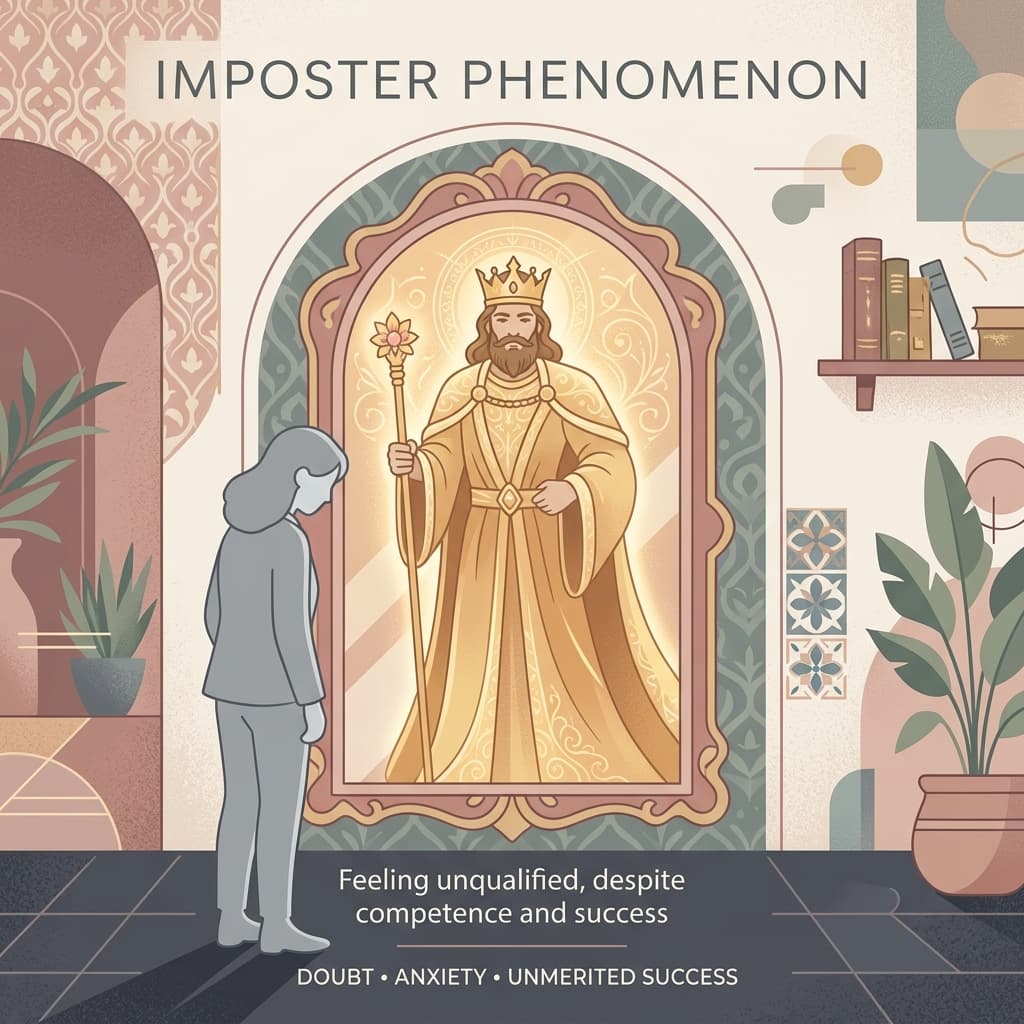
Do you feel like a "fraud"? Do you worry that one day everyone will realize you don't actually know what you're doing, despite your achievements? This is the Imposter Phenomenon (often called Imposter Syndrome). It affects up to 70% of high-achievers. It is not a sign of low ability, but a byproduct of high standards and the "Dunning-Kruger Effect" in reverse.
01The 5 Faces of Imposterism
Dr. Valerie Young identified five distinct subtypes of people who experience imposter feelings:
1. **The Perfectionist**: Believes that unless they were perfect, they could have done better.
2. **The Superhuman**: Believes they should be able to handle all roles (parent, partner, professional) perfectly and with ease.
3. **The Natural Genius**: Believes that if they have to work hard at something, they must not be "good" at it.
4. **The Soloist**: Believes they must do everything themselves; asking for help is a sign of failure.
5. **The Expert**: Believes they will never know enough and is constantly in search of one more certification or degree.
- Perfectionists fear minor flaws.
- Natural Geniuses fear effort.
- Soloists fear dependency.
02The Pluralistic Ignorance
We experience Imposter Syndrome because we compare our "internal blooper reel" with everyone else's "external highlight reel." We know all our doubts, failures, and lucky breaks, but we only see the polished success of others. This "Pluralistic Ignorance" creates the illusion that we are the only ones faking it.
Warning
The more competent you become, the more you realize what you DON'T know. This is why experts often feel like imposters while beginners feel like masters.
03Breaking the Cycle
To overcome the phenomenon, you must "Externalize the Voice." Stop saying "I am a fraud" and start saying "I am having a thought that I am a fraud." By creating distance between your identity and the imposter thought, you strip it of its power. Additionally, keep a "Proof Portfolio" — a physical or digital folder of your wins, positive feedback, and completed projects.
04From Imposter to Learner
Shift your identity from "The Expert" to "The Continuous Learner." Experts are afraid of being wrong. Learners are excited by it because it means they are growing. When you embrace a "Growth Mindset," being "found out" as someone who doesn't know everything is no longer a threat — it is just the current state of your evolution.
Key Takeaways
- 1Imposter Syndrome is a sign of high standards, not low ability.
- 2Identify your subtype (e.g., The Soloist) to target your growth.
- 3Stop comparing your "Internal Blooper Reel" to others' "Highlight Reel."
- 4Externalize the imposter voice to reduce its emotional impact.
- 5Adopt the identity of a "Learner" rather than an "Expert."
Continue Reading
Behavioral Science
Emotional Intelligence (EQ-i)
13 min · The 5 Pillars of Relational and Self-Intelligence