Cognitive Psychology 12 min read
The Locus of Control
Mastering the Internal vs. External Drivers of Success
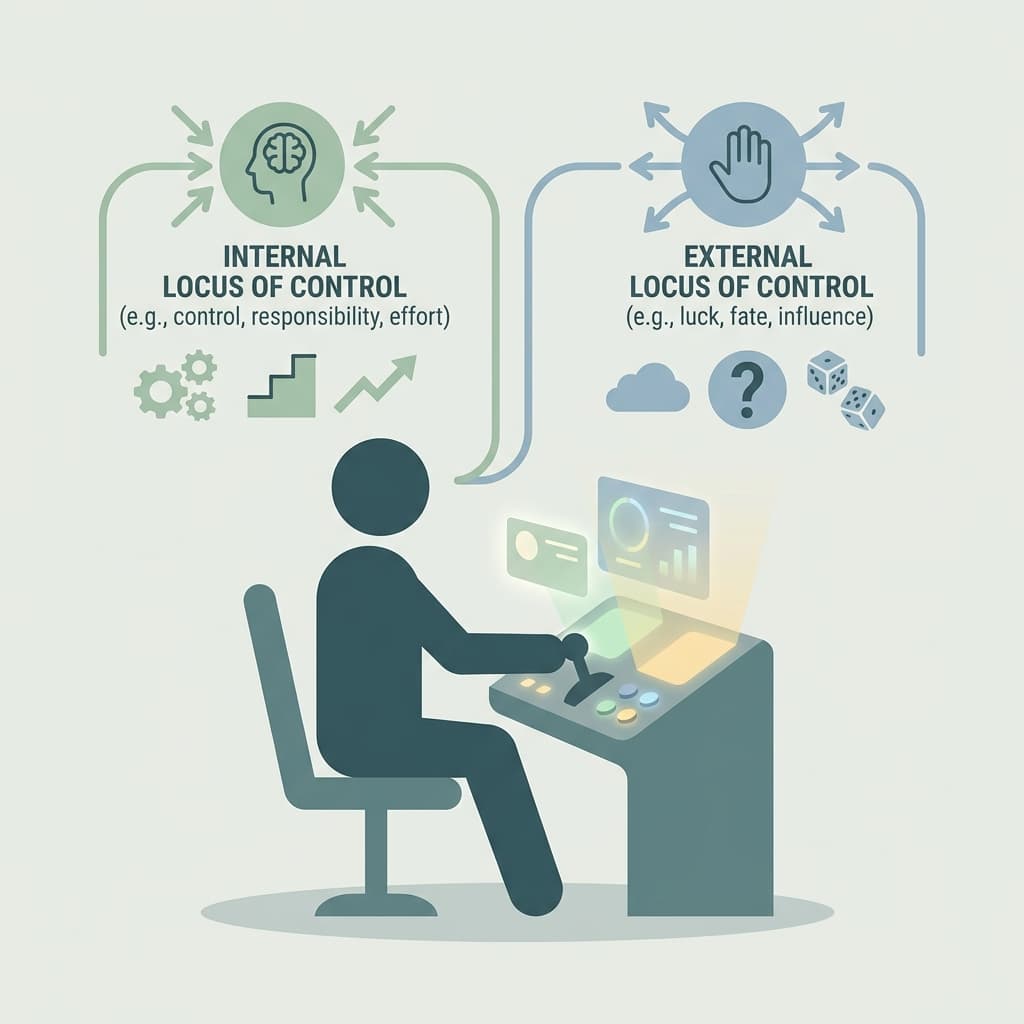
"It is not what happens to you, but how you react to it that matters."
— Epictetus
Do you believe you are the architect of your destiny, or a leaf in the wind of fate? This is the core of the "Locus of Control" — a psychological concept developed by Julian Rotter. Your position on this spectrum determines how you handle failure, how much stress you experience, and how likely you are to take proactive steps toward your goals.
01Internal vs. External
A person with an **Internal Locus of Control** believes that their rewards and outcomes are the direct result of their own actions. A person with an **External Locus of Control** believes that their life is primarily shaped by luck, fate, or powerful others. While most people fall somewhere in the middle, having a "Internal-Leaning" locus is strongly correlated with higher academic achievement, better health outcomes, and greater career satisfaction.
- "I make things happen."
- "Things happen to me."
- The spectrum: Most people are a mix depending on the context.
02The Stress Connection
The Locus of Control is a primary predictor of stress. Those with an External Locus often feel a sense of "Learned Helplessness" — a state where they stop trying to improve their situation because they believe effort is futile. Conversely, those with an overly Internal Locus can experience "Hyper-Responsibility," leading to burnout and self-blame for things that are truly beyond their control.
Key Insight
The goal is not to be 100% Internal, but to have "Realistic Agency" — knowing what you can change and accepting what you cannot.
03Shifting Your Locus
Can you change your Locus of Control? Yes. It begins with "Attributional Retraining." When you succeed, consciously attribute it to your effort or skill (Internal). When you fail, distinguish between what was your fault and what was bad luck. By repeatedly acknowledging your own agency in small wins, you physically reshape the neural pathways that define your sense of power.
04The Agency Audit
Take a current problem in your life and perform an Agency Audit. Divide a page into two columns: "Controllables" and "Uncontrollables." Focus 100% of your energy on the Controllables. This practice immediately shifts the Locus of Control from the abstract (fate) to the actionable (behavior).
- "Controllables" (Effort, Attitude, Schedule)
- "Uncontrollables" (Other people, The economy, Past events)
- Energy Allocation: 100% on the left column.
Key Takeaways
- 1The Locus of Control is your belief about who controls your life.
- 2Internal Locus is linked to higher resilience and achievement.
- 3External Locus can lead to learned helplessness and chronic stress.
- 4Agency can be trained through attributional retraining.
- 5The "Agency Audit" is the fastest way to regain a sense of control.
Continue Reading
Philosophy & Psychology
Stoic Resilience
14 min · Applying Ancient Cognitive Frameworks to Modern Stress