Understanding the Psychological Root of Polarization
"Morality binds and blinds. It binds us into ideological teams that fight each other as though the fate of the world depended on it, and it blinds us to the fact that each team is composed of good people who have something important to say."
— Dr. Jonathan Haidt, The Righteous Mind
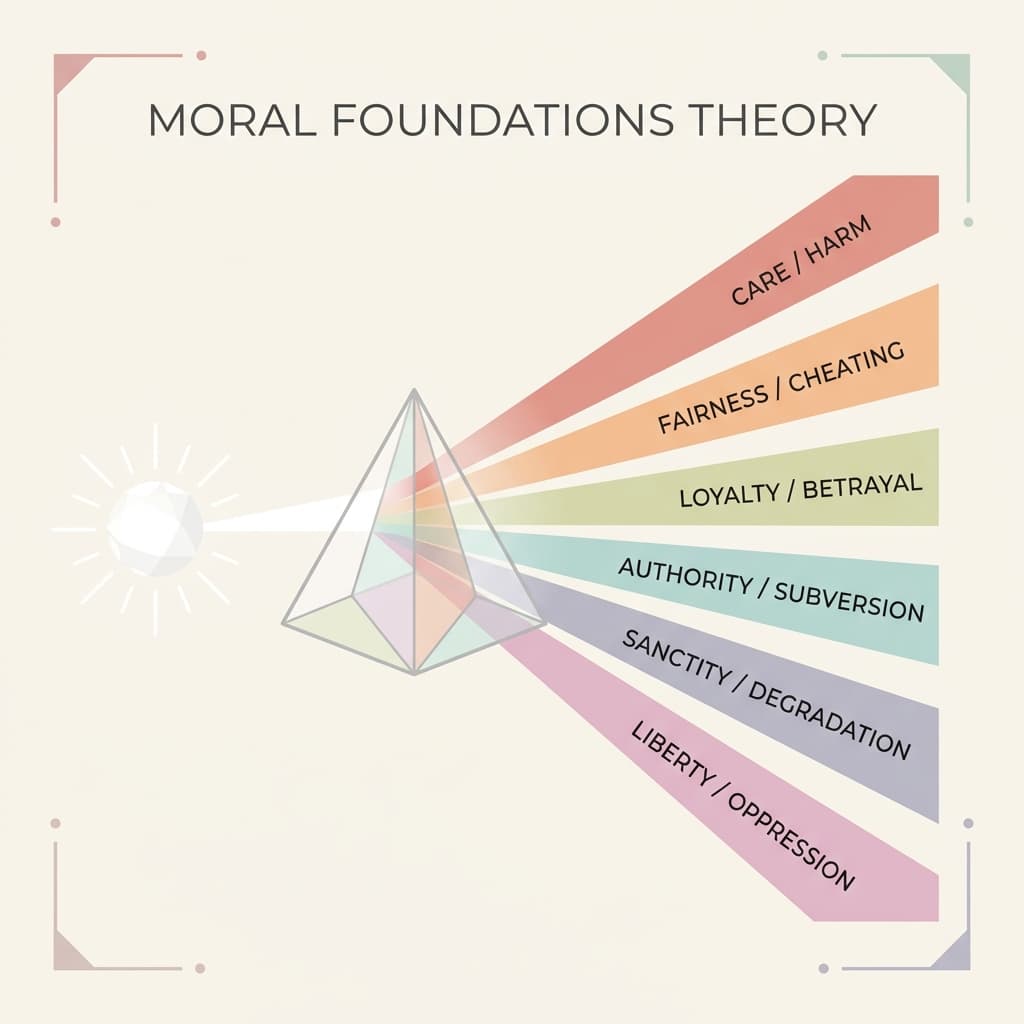
Why is it so hard for us to talk across political and social divides? The answer lies not in our lack of logic, but in our divergent "Moral Foundations." Research by Jonathan Haidt and others suggests that humans possess six intuitive moral "taste buds." Understanding how these foundations are weighted in your own psyche — and in those you disagree with — is the key to navigating the modern polarized landscape.
01The 6 Moral Taste Buds
Just as the tongue has receptors for sweet, salty, sour, bitter, and umami, the human mind has receptors for different moral dimensions:
1. **Care/Harm**: Sensitivity to the suffering of others.
2. **Fairness/Cheating**: Justice, rights, and proportionality.
3. **Loyalty/Betrayal**: The importance of group cohesion and sacrifice.
4. **Authority/Subversion**: Respect for legitimate hierarchy and tradition.
5. **Sanctity/Degradation**: The sense that some things are "sacred" and should not be polluted.
6. **Liberty/Oppression**: Resistance to illegitimate coercion and dominance.
Care & Fairness: The "Individualizing" foundations
Loyalty, Authority, Sanctity: The "Binding" foundations
Liberty: The shared foundation of resistance to tyranny
02The Ideological Split
Psychological research shows a distinct pattern in how different ideologies weigh these foundations. Progressives (Liberals) tend to weigh Care and Fairness extremely high, while being more skeptical of Loyalty, Authority, and Sanctity. Conservatives tend to weigh all six foundations more equally. This is why a progressive might see a conservative's emphasis on "tradition" as oppressive, while a conservative might see a progressive's emphasis on "fairness" as a threat to social stability.
Key Insight
We aren't disagreeing about facts; we are disagreeing about which moral dimensions "count" more in a given situation.
03The Empathy Gap
The "Moral Foundations Gap" creates an empathy blind spot. It is psychologically difficult to recognize the moral validity of a foundation you don't personally weigh heavily. To a "Care-dominant" person, a "Sanctity-dominant" argument can sound like irrational superstition. To a "Loyalty-dominant" person, a "Fairness-dominant" argument can sound like betrayal of the group. Bridging the gap requires "Moral Reframing" — translating your values into the moral language of your counterpart.
04Practical Application: Depolarization
To lower the temperature in a heated discussion, identify which foundation your counterpart is leaning on. If they are talking about "respecting our heritage" (Authority/Loyalty), don't counter with "but it's not fair" (Fairness). Instead, frame your argument in terms of Loyalty: "To be truly loyal to our country's future, we must address these issues." This "Moral Translation" bypasses the brain's threat response and allows for genuine dialogue.
Identify the counterpart's dominant foundation
Avoid "Moral Colonialism" (trying to force your foundations on them)
Use "Moral Reframing" to speak their language
Validate their foundation before introducing your own
Key Takeaways
1Morality is based on 6 intuitive foundations (taste buds).
2Different ideologies weigh these foundations differently.
3Polarization occurs when we fail to see the moral validity of other foundations.
4Moral Reframing is the key to persuasive and empathetic dialogue.
5Bridging the gap starts with intellectual humility.